Save big on select artwork!

Beyond the Circle: Unpacking the World of Handmade Mandalas
More Than Just Pretty Patterns
1/20/20264 min read
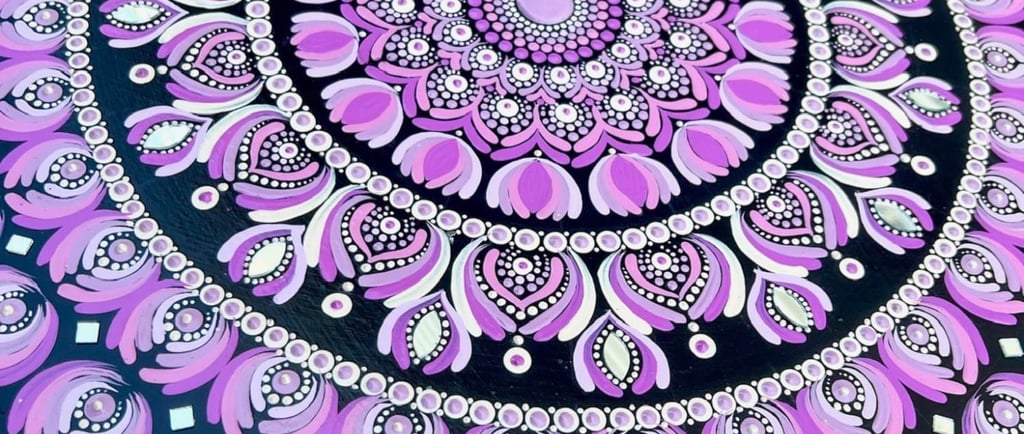
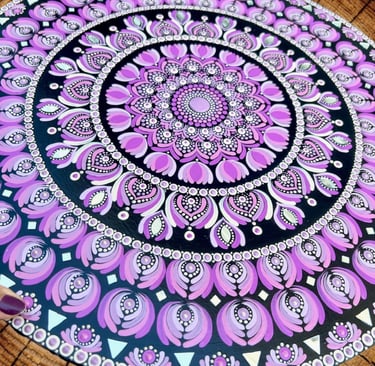
Ever get lost in a swirling, intricate design? That's the magic of mandalas, isn't it? These captivating patterns draw the eye and, if we allow, the mind along with it. Handmade mandalas are ancient art forms with spiritual roots, now finding new life as tools for mindfulness, unique decor, and potent avenues for artistic expression. But what makes them handmade special? It's a question worth pondering. Mass-produced versions, for all their technical precision, often lack the palpable intention, the subtle imperfections, and the sheer presence that a handmade mandala exudes.
Chapter 1: Where Did These Circles Come From? A Historical Spin
Ancient Echoes:
The whispers of mandalas echo from the distant past, specifically 1500-500 BCE in ancient India, subtly woven into the fabric of the Rig Veda. These weren't merely decorative flourishes; they held profound significance. Consider Hinduism's Yantras, geometric arrangements serving as potent symbols of the cosmos, deeply intertwined with meditation practices. I'm envisioning these intricate diagrams meticulously drawn in sand, ephemeral representations of enduring cosmic principles. Then there's Buddhism's Journey, inextricably linked to Siddhartha Gautama's enlightenment. The Silk Road became a conduit, not just for trade, but for the diffusion of mandalas across Asia, leaving its indelible mark on Tibet, China, and Japan.
Beyond Asia:
It's tempting to see mandalas as solely an Eastern phenomenon, but I wonder, isn't there something inherently universal about the circle? A quick nod to similar circular patterns worldwide—the intricate Celtic knots, the powerful Native American medicine wheels, the awe-inspiring rose windows of Gothic cathedrals—suggests a deeper resonance. Perhaps it's something embedded in our human psyche, an archetypal form that speaks to our innate sense of wholeness and cyclical existence.
Carl Jung's Contribution:
And then there's Carl Jung, the Swiss psychologist, who brought mandalas to the Western world, not as exotic artifacts, but as potent symbols of the self and invaluable tools for psychological integration and wholeness. It's a fascinating perspective, isn't it? Seeing the mandala as a mirror reflecting our inner landscape, a canvas upon which we project our hopes, fears, and aspirations.
Chapter 2: The Mandala Medley: What's Happening Now?
Art for the Soul (and the Walls!):
Mandalas today exist as a vibrant and compelling mix of tradition and contemporary trend. The ancient and the modern dance together, creating a spectacle of creativity and cultural expression.
Therapeutic Trend: They're big on mindfulness, stress reduction, and emotional healing, and there's a reason for this. The act of creation itself is the journey, the focused attention, the rhythmic repetition, all contribute to a meditative state, a temporary reprieve from the incessant chatter of the mind.
Decor Dominance: Mandalas aren't just relegated to temples or meditation rooms anymore! They've infiltrated our living spaces, adorning large-scale murals in yoga studios, intricately woven designs on bedsheets, illuminating lampshades, and even standing as bold statement pieces in modern homes.
Artistic Evolution:
And the artistic explorations are particularly compelling. Dot mandalas are receiving shimmering metallic makeovers, transforming them into objects of opulence. Minimalist designs are proving that less is often more, harnessing the power of simplicity to convey profound meaning. Artists are fearlessly mixing old and new, juxtaposing ancient lotus motifs with contemporary flair. There's a veritable texture party underway, with mandalas crafted from wood, poured resin, and laser-cut metal, adding a tactile dimension to the visual experience. The stark elegance of black and white offers a striking, serene vibe, a visual counterpoint to the often vibrant colors associated with mandalas. And let's not forget illuminated mandalas, blending tradition with cutting-edge technology to create mesmerizing displays that seem to breathe with light.
Chapter 3: The Sticky Side: Mandalas and Cultural Appropriation
The Heart of the Matter:
This undeniably beautiful art form comes intertwined with a complex conversation about respect, responsibility, and the potential for cultural appropriation.
Sacred vs. Trendy: We must always remember mandalas' origins as profound spiritual tools in Hinduism and Buddhism, serving as focal points for meditation, contemplation, and connection to the divine.
The "Mandala Craze" Quandary: The line between appreciation and appropriation can often become blurred, particularly in the context of a widespread "mandala craze". Is it truly okay to get a "pretty" mandala tattoo simply because it's aesthetically pleasing, without even a cursory understanding of its deeper meaning? Does using mandalas solely as bedroom decor, divorced from their spiritual context, risk trivializing their profound significance? The examples are abundant: "sexy tattoos" that flatten a rich visual language into mere ornamentation, or "hippie room decorations" that sanitize powerful symbols into bohemian clichés.
Finding the Balance:
So, how do we navigate this complex terrain and engage with mandalas respectfully? It's about education, seeking genuine understanding, and honoring their origins, not just exploiting their aesthetic appeal for personal gain.
Chapter 4: The Mandala Forecast: What's Next on the Horizon?
Digital Meets Handmade:
The convergence of technology and traditional craftsmanship is particularly intriguing. I'm seeing artists using apps and specialized software to meticulously design intricate mandalas before bringing them to life by hand, bridging the gap between digital precision and the irreplaceable human touch.
New Materials, New Frontiers:
Laser cutters are enabling the creation of stunning wood and metal mandalas, pushing the boundaries of material expression. Advanced dotting techniques are allowing for the creation of even more intricate textures, adding depth and dimension to the mandala's surface.
Global Fusion:
I anticipate a growing trend of global fusion, with artists seamlessly blending Zen, Celtic, and African patterns, creating mandalas that reflect a truly interconnected world.
Eco-Conscious Creations:
There's also a rising consciousness around sustainability, with artists embracing eco-conscious practices by using natural dyes and recycled materials, aligning their art with their environmental values.
Immersive Experiences:
The seeds for VR mandalas are already here, allowing for deeply immersive and interactive meditative experiences. Could handmade versions be digitized for interactive meditation, offering a new way to engage with these ancient symbols?
Ever-Expanding Applications:
I foresee ever-expanding applications in tattoos, street art, personalized gifts, and continued growth in art therapy and educational settings, solidifying the mandala's place as a potent force for creativity, healing, and connection.
Conclusion: A Timeless Circle, Ever Evolving
From ancient rituals to modern mindful practice, handmade mandalas are powerful symbols that continue to resonate across cultures and generations.
Whether employed for spiritual growth, artistic expression, or simply as a source of calming decor, these intricate circles continue to captivate, connect, and evolve. What will your mandala say about you? It's a question worth pondering, a journey worth embarking upon, into the heart of the circle and, ultimately, into the depths of yourself.
Get in touch
Contact@onlinearthub.com
Copyright © 2025 OnlineArtHub | Powered by OnlineArtHub